
B2B Technology Solutions Partner

Service / Modernise & Connect

API & System Integration

Explore how systems and information may connect through APIs and integration patterns.

  • Defined data exchange
  • Failures handled visibly
  • Built around the process
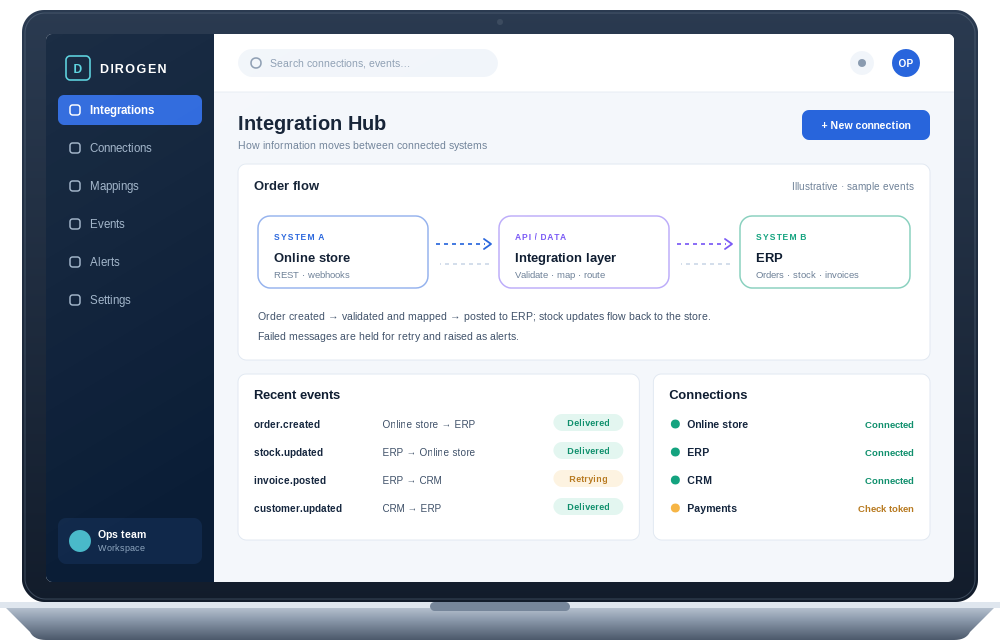
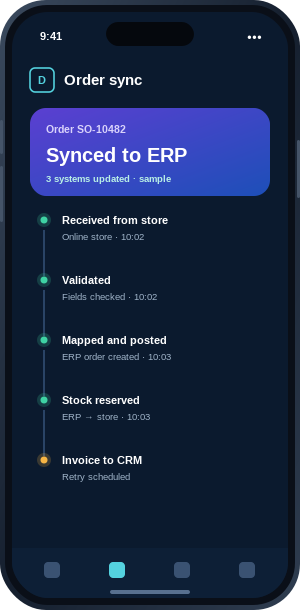
Illustrative integration hub on a laptop, showing an order flow from an online store through an integration layer to an ERP Illustrative mobile timeline of one order moving between connected systems
Sample concept · illustrative data, not a client project

Connected by design

Systems that share what they need to.

  • Follow the process

    Design each connection around the business step it supports, not just the technology.

  • Agree the data

    Define which records move, in which direction, and which system is the source of truth.

  • Plan for failure

    Validate, retry and raise alerts so problems are seen and fixed, not lost.

Service summary

At a glance

Business need
Separate systems may require a defined data exchange or connection approach.
Capability area
API design · System integration
Illustrative possibilities
A possible integration pattern for agreed systems and data, subject to technical discovery.
Related systems
System A · API / data · System B

Illustrative system flow

  1. 01System A
  2. 02API / Data
  3. 03System B

What we can connect

API and integration capabilities

The right pattern depends on the systems involved, the volume of information and how quickly it needs to move.

  • API design

    Clear, documented APIs for your own applications and partners.

  • Application integration

    Connect ERP, CRM, e-commerce and other business applications.

  • Data mapping and transformation

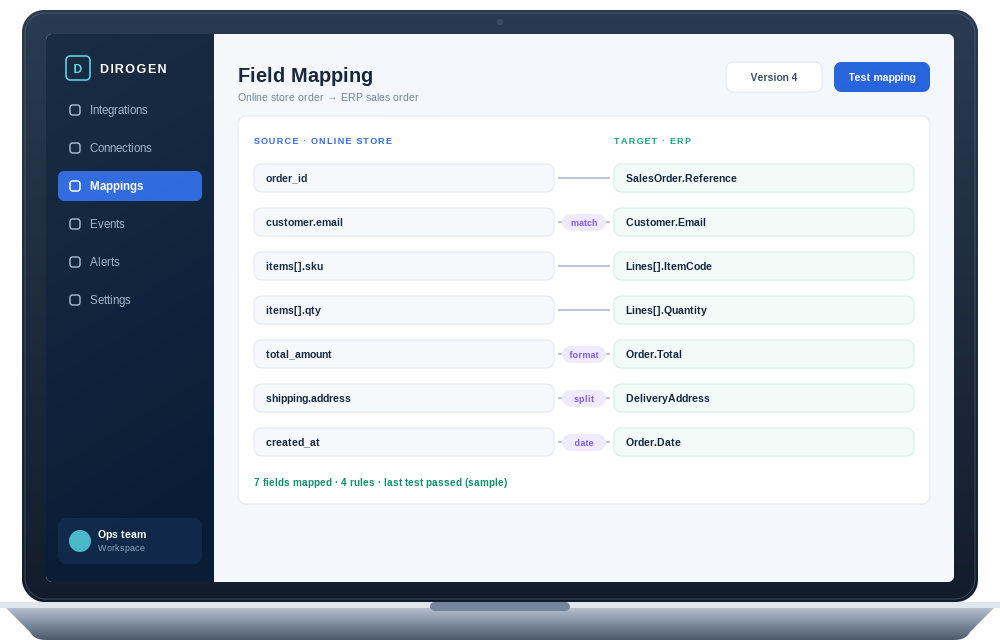
    Translate fields and formats so each system receives what it expects.

  • Event and workflow integration

    Trigger actions in one system when something changes in another.

  • Legacy system connectivity

    Find practical ways to connect older systems that were not built for APIs.

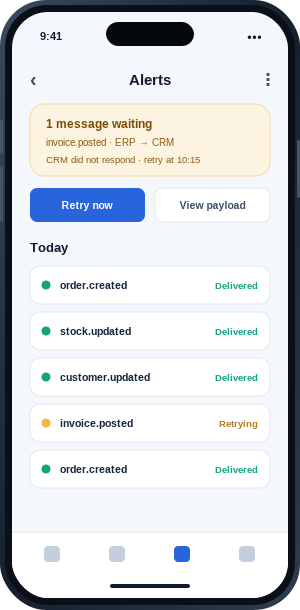
  • Monitoring and alerts

    See what moved, what failed and what is waiting for a retry.

Follow the data

See how information could move

Choose an event to follow it between systems. These are illustrative examples; the actual pattern is agreed during technical discovery.

Illustrative eventNew order

  1. System A Online store Order placed
  2. API / Data Integration layer Validate and map
  3. System B ERP Sales order created

What moves

  • Order number
  • Customer
  • Items and quantities
  • Delivery address

Checked on the way

  • Required fields are present
  • Item codes exist in the ERP

If something fails

The order is held and an alert is raised, so it can be corrected and sent again.

Illustrative eventStock change

  1. System A ERP Stock level updated
  2. API / Data Integration layer Filter and convert
  3. System B Online store Availability refreshed

What moves

  • Item code
  • Available quantity
  • Location

Checked on the way

  • Only items sold online are sent
  • Quantities are never negative

If something fails

The last known value stays in place and the update is retried.

Illustrative eventCustomer update

  1. System A CRM Contact details changed
  2. API / Data Integration layer Match the record
  3. System B ERP Customer record updated

What moves

  • Customer ID
  • Billing address
  • Contact email

Checked on the way

  • The customer exists in both systems
  • The agreed system of record wins

If something fails

Unmatched records are listed for review instead of creating duplicates.

About this service

In more detail

Connect applications, platforms and data through integration approaches designed around business workflows and system requirements.

DIROGEN helps businesses connect systems and applications so information and processes can move more effectively across the technology environment. The focus is on understanding how systems need to interact and shaping integration around the business process they support.

From APIs and application connectivity to data exchange and connected workflows, we consider the relationships between systems rather than treating each application as an isolated component.

The approach can include API integration, system connectivity, data integration or workflow integration depending on the existing environment and project requirements.

Our approach

From discovery to dependable connections

Integration work starts with the process and the data, then moves to building and monitoring.

  1. 01

    Discover

    Review the systems, their APIs or interfaces, and the process they support.

  2. 02

    Define

    Agree data ownership, field mapping, timing and error handling.

  3. 03

    Build and test

    Develop the integration and test it with realistic data and failure cases.

  4. 04

    Monitor

    Go live with logging and alerts, then refine as volumes and needs change.

Industries

Relevant industries

See how this service applies in the industry closest to yours.

Next steps

Let’s connect the systems you rely on.

Tell us which systems need to talk to each other. We’ll explore a practical integration approach.